What Does It Actually Cost to Live in Venice, California in 2026?
Venice, CA home prices in 2026 range from ~$1.9M citywide to $5M+ on the Canals. Here's the price bands, streets, and Coastal Commission rules that shape them.
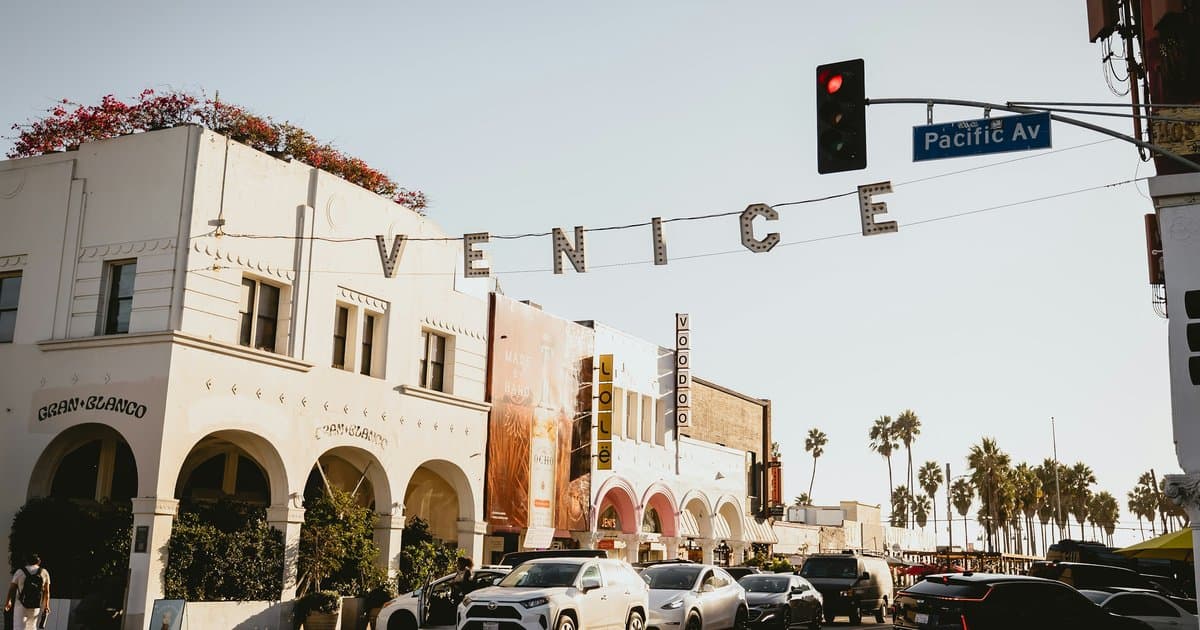
What does it actually cost to live in Venice, California in 2026? Depending on which few blocks you mean, the answer swings from a little over $1M for an inland fixer to well past $5M on the canals. Venice isn't one market. It's four or five small ones stacked inside the same zip code, and the price you pay has more to do with which street you're standing on than almost anywhere else on the Westside.
A neighborhood that refuses to be one thing
Drive from Lincoln Boulevard to the beach and you pass through what feels like four different towns. Inland, it's still possible to find a modest single-story cottage that hasn't been touched since the 1960s. Cross Abbot Kinney and the housing stock turns into architect-built infill, glass and cedar, the kind of construction that shows up in design magazines. Keep going toward the water and you hit the Venice Canals, a man-made system of waterways lined with some of the most expensive small lots in Los Angeles. And tucked between the canals and the boardwalk are the Walk Streets, a cluster of pedestrian-only lanes where the front doors face a landscaped walkway instead of a car street.
Recent sale data reflects that split. Redfin's citywide Venice numbers put the median sale price around $1.9M in March 2026, while Movoto reported a $2,595,000 median for April 2026 (Movoto, Redfin). Neither number is wrong. They're measuring different slices of the same nine-digit zip code. Zoom into the Venice Canals specifically and Redfin's most recent monthly figure was a $5.1M median sale price, up 54.7% year over year, with a dozen active listings at a median list price of $2.79M ranging from about $1.75M to $5.3M (Redfin, Venice Canals). The Walk Streets micro-market runs a comparable band, commonly cited around $2M to $6M depending on lot size and proximity to the water (Own Luxury Homes).
The streets that set the price
Abbot Kinney Boulevard is the commercial spine of the neighborhood, and it does more to set property values than any single amenity in Venice. Forbes has called it "America's Coolest Street" and GQ named it "the Coolest Block in America" (Forbes Global Properties). It grew from a strip of independent shops into a mile-long corridor of restaurants and boutiques that now draws comparisons to Melrose Avenue and Rodeo Drive. Homes within a few blocks of Abbot Kinney carry a walkability premium that shows up directly in list price.

Marco Place, Amoroso Place, Nowita Place, and Crescent Place make up the Walk Streets, a pocket of homes built more than a century ago that face each other across a shared pedestrian walkway instead of a paved street (Dogtown Realty). There's no through traffic on these blocks, which is part of what keeps demand steady even as prices in the rest of the neighborhood move around.
And then there are the Canals. Built as a residential waterway system, the Canals are the highest-priced micro-market in Venice on a per-square-foot basis, and the architecture along the water ranges from restored 1920s bungalows to full modern rebuilds.
Who's buying in Venice right now
The housing stock itself tells you who the buyer pool looks like. Inventory ranges from single-story beach cottages to multi-level new construction, condos, and canal-front or beachfront lots, which means the neighborhood supports everything from a starter purchase inland to a full architectural statement house near the water. Proximity to employers plays a real role here too. Google has occupied the "Binoculars Building" on Main Street since 2011 and has since expanded into surrounding buildings, part of the broader Silicon Beach corridor that runs from Santa Monica through Venice, Marina del Rey, and Playa Vista (Built In LA).
That employer base is shifting. Snap Inc. recently moved its headquarters out of Venice to Blackstone's Santa Monica Business Park, and the former Snap office and mixed-use portfolio in Venice went up for sale at roughly $80M, with a proposal on the table to redevelop part of the site into housing and retail (Bisnow, Urbanize LA). It's worth watching for anyone weighing a purchase near the Main Street corridor, since a large commercial-to-residential conversion tends to change what gets built (and who's renting or buying) in the surrounding blocks over the next several years.
Coastal rules that don't apply everywhere else in LA
Venice sits inside California Coastal Commission jurisdiction, which adds a layer of review that inland LA neighborhoods don't deal with. Any new construction, major remodel, or seawall/bulkhead work near the canals or the beach can require a Coastal Development Permit on top of the standard city process. This matters more here than in most of Los Angeles because of what's projected for the canals specifically: a Coastal Commission-cited study found the canals are likely to see more frequent flooding from winter storms within the next 25 to 50 years as sea levels rise, since the canal system drains into Marina del Rey through tide gates that only function at low tide (Yo! Venice). In 2016, California expanded the Coastal Commission's authority to weigh sea-level adaptation when it reviews permits, which is now a standard part of due diligence on canal-front and beachfront property here.
None of this means canal or beachfront property is a bad purchase. It means the disclosure package, the permit history, and the flood zone designation deserve a closer read in Venice than they would three miles inland, and it's worth building that review into your timeline before you're deep into escrow.
Buyers actively comparing Venice against a purchase further inland, or sellers timing a listing around next year's insurance renewal, are welcome to schedule a private consultation to go through the specific parcel, permit history, and disclosure package for a Venice property.
How Venice compares to its neighbors
Santa Monica, Marina del Rey, and Venice all sit inside the same Silicon Beach corridor, but they price and operate differently. Santa Monica condo medians commonly run $1.1M to $1.4M, with more formal beachfront amenities, city-managed parking garages, and some of the strictest short-term rental limits on the Westside (The Malibu Life). Marina del Rey is a smaller, marina-first market, with medians often in the mid six figures to around $1M outside of waterfront towers, and a quieter evening pace than Venice. Venice itself carries the highest medians of the three once the Canals and Walk Streets are factored in, uses Preferential and Residential Permit Districts for parking rather than centralized garages, and has the most architecturally varied housing stock of the three.
| Venice | Santa Monica | Marina del Rey | |
|---|---|---|---|
| Typical price range | ~$1.9M-$2.6M citywide; $2.79M+ median in the Canals | ~$1.1M-$1.4M (condo median) | Mid six figures to ~$1M+ (waterfront premium) |
| Housing stock | Cottages, modern infill, canal and walk-street homes | Condos and formal beachfront buildings | Condos and marina-view towers |
| Parking structure | Preferential/Residential Permit Districts | City-managed garages plus residential permits | Structured building parking, county marina lots |
| Coastal Commission jurisdiction | Yes | Yes | Yes |
Frequently Asked Questions
What is the median home price in Venice, CA in 2026? It depends heavily on the block. Citywide figures for Venice have run from roughly $1.9M to $2.6M across different months and data providers in 2026, while the Venice Canals specifically have posted a $5.1M median sale price in the most recent reporting period (Redfin).
What are the Venice Walk Streets? Marco Place, Amoroso Place, Nowita Place, and Crescent Place are pedestrian-only streets where homes face a shared walkway instead of a paved road, built more than a century ago and still car-free today (Dogtown Realty).
Is Venice under California Coastal Commission jurisdiction? Yes. New construction, substantial remodels, and certain waterfront work near the canals and beach can require a Coastal Development Permit in addition to standard city permitting, and sea-level adaptation is now part of that review (Yo! Venice).
How does Venice compare to Santa Monica for a buyer? Venice generally carries higher medians once the Canals and Walk Streets are included, has a more architecturally mixed housing stock, and uses permit-district parking rather than Santa Monica's city-managed garage system.
Why is Abbot Kinney Boulevard relevant to home values in Venice? Abbot Kinney is the commercial and cultural spine of the neighborhood, and proximity to it carries a measurable walkability premium in list prices for homes in the surrounding blocks (Forbes Global Properties).
Thinking about what a Venice property, canal-front or otherwise, is worth in today's market? Request a confidential valuation and get a clear picture before you list.
Working the Westside from Santa Monica through the canyons and down to the coast means watching Venice's block-by-block pricing shift in real time, not reading it secondhand. Paul Blair is the founder and broker of Grey Square, a virtual real estate brokerage representing buyers and sellers across Dallas and Los Angeles. With 22 years in the business and more than $200 million in closed transactions, Paul works the full range of the market, from luxury homes in the Park Cities and Preston Hollow to estates in the Hollywood Hills and across the Westside. Connect with Paul and the Grey Square team at greysq.com. TX TREC #9011505, CA DRE #01792671.
Related reading: What Does It Actually Cost to Live in Laurel Canyon in 2026?, Coming Soon Listings in Los Angeles: The New CRMLS Rules Every Seller Needs to Know, and CA FAIR Plan Rate Increase October 2026: What Los Angeles Sellers and Buyers Need to Know.
Browse current Venice-area inventory at Search Los Angeles.